SKU: 27806281184
lowes succulent

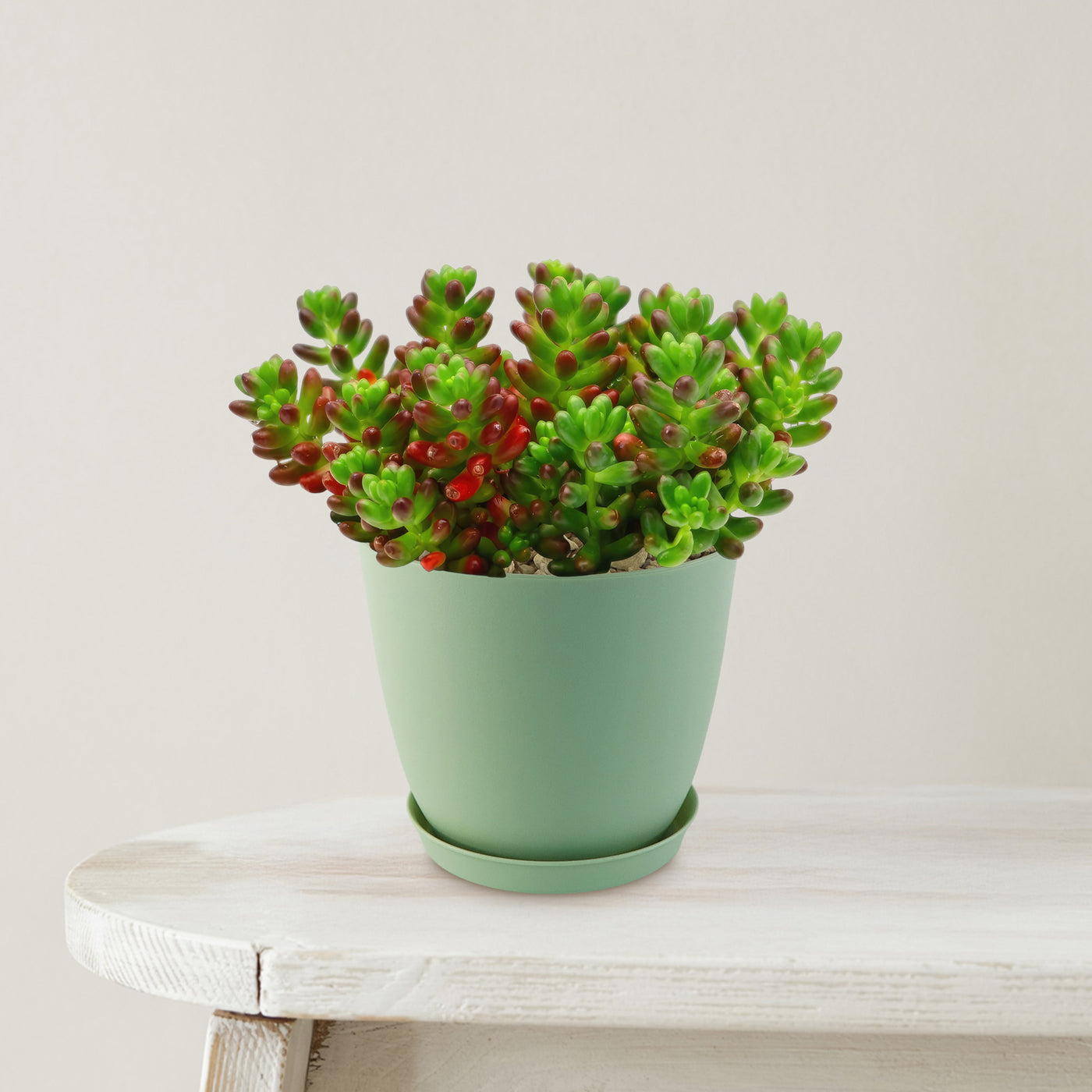
lowes succulent Jelly Bean Succulent 'Sedum rubrotinctum' 6" Pot / Light Green / With Pot

Sale price$19.66 Regular price$21.84
Save 10%

Pay in installments of $5.46 with ShopPay, AfterPay and Klarna

Shipping Estimate
USA
  • USA
  • CAN

Ships within 48 hours · Estimated delivery Aug 21 - Aug 26

Promo Codes Available:

For Your Every Summer RSVP, with Code: SUMMER15

Description

lowes succulent Jelly Bean Succulent 'Sedum rubrotinctum' 6" Pot / Light Green / With PotIntroducing the Jelly Bean Plant, botanically known as Sedum rubrotinctum, is a charming, low growing succulent admired for its colorful, bead like foliage. Its cascading stems make it an excellent choice for hanging baskets, window boxes, and container arrangements, where its colorful foliage can spill over the edges beautifully. Native to Mexico, this evergreen perennial is commonly called pork and beans or banana cactus due to its plump, jelly bean

Introducing the Jelly Bean Plant, botanically known as Sedum rubrotinctum, is a charming, low-growing succulent admired for its colorful, bead-like foliage. Its cascading stems make it an excellent choice for hanging baskets, window boxes, and container arrangements, where its colorful foliage can spill over the edges beautifully.

Native to Mexico, this evergreen perennial is commonly called pork and beans or banana cactus due to its plump, jelly bean-shaped leaves that give it a playful and unique appearance.

This hybrid jelly bean succulent has small, fleshy leaves that start out green but develop vibrant shades of red, orange, or bronze when exposed to bright sunlight, making it a standout in any succulent collection.

It is often used as a ground cover in rock gardens or featured in decorative containers and dish gardens.

As the plant matures, Sedum rubrotinctum typically reaches about 8 inches tall and up to 24 inches wide, forming a spreading, trailing habit.

Jelly bean succulent flowers are yellow, small, and star-shaped, blooming in clusters at the tips of their stems.

While the blooms are subtle, they provide a delicate contrast to the bold foliage and usually appear in spring to early summer.

Related Product

What truly makes the jelly bean succulent so popular is its combination of low-maintenance care and vibrant color transformation. It is drought-tolerant, easy to grow, and adapts well to both indoor and outdoor environments with proper light. Its ability to change color with sunlight adds dynamic beauty throughout the year.

When and How to Water Your Sedum rubrotinctum Plant

This jelly bean succulent is highly drought-tolerant and prefers drying out between waterings, making it more resilient to underwatering than overwatering.

The Sedum rubrotinctum should be watered once every 1-2 weeks during the growing season, with light soaking and minimal watering once every 3-4 weeks during the dormant season, with very light moisture.

During the active growing season, allow the soil to dry out completely between waterings. This helps prevent overwatering, which can cause the Sedum rubrotinctum roots to rot.

During the dormant season, your jelly bean requires even less water. It's important to remember that succulents like the jelly bean plant are more tolerant of underwatering than overwatering.

Light Requirements - Where to Place Your Jelly Bean Succulent

When growing indoors, you can grow it in the areas where it can receive atleast at least 6 hours of bright, direct light to maintain their vibrant red coloring and compact, healthy growth. 

Place it near a window that receives plenty of sunlight, but make sure to protect your jelly bean plants from direct exposure to intense sunlight, especially during the hottest parts of the day.

A south or west facing window works best, but protect it from harsh midday sun. If natural light is limited, you can use grow lights. 

When growing outdoors, it loves basking in the full sun, so find a location in your garden or patio that receives at least 6 hours of direct sunlight each day. 

When grown in direct sunlight, the color ranges from bright green leaves to red-tipped leaves, with the brightest hues.  However, it's important to note that the jelly bean plant can also tolerate partially shaded areas, especially in regions with intense summer heat. 

Newly purchased jelly bean succulent may burn if placed in full sun right away, so increase exposure gradually.

  1. If the leaves stretch or turn pale, it needs more light.
  2. If they become scorched or develop brown spots, it is getting too much sun.

Optimal Soil & Fertilizer Needs 

The Sedum rubrotinctum favors very airy, sandy soil that drains well, and NPK fertilizers once a year in spring. Planting your Sedum rubrotinctum in ordinary wet soil will result in compacted roots, stunted growth, and, most likely, root rot. Instead, make or buy a well-draining potting mix, or ideally, use our Go to Soil cactus mix blend 1 gal 4 qt cacti succulent dirt compost growing media that contains organic mycorrhizae to promote the development of a strong root system that helps your jelly bean plants and other succulents to thrive. 

A balanced, low-strength fertilizer works best for your Jelly bean succulent plant, ideally with an NPK ratio around 5-10-5, where phosphorus is slightly higher than nitrogen to support healthy growth. Apply fertilizer once in spring at the start of the growing season to give it a gentle boost to support stronger roots and better nutrient absorption. 

Hardiness Zones & More 

In the United States, this jelly bean succulent is mostly an indoor plant, but if you live in southern Florida or Hawaii, then you can cultivate it outdoors in USDA zones 9-11.

If you live in a colder climate, it's best to bring the jelly bean plant indoors or provide some protection during the winter months.

As for humidity, the jelly bean plant can handle a range of humidity levels, from drier to more humid environments. Just ensure that the soil has good drainage to prevent waterlogged conditions. 

How to Grow as a Houseplant 

Your jelly bean succulent grows best indoors in temperatures between 60°F and 75°F. It can tolerate slightly cooler temperatures during the winter months, but it's best to keep it away from drafts or extreme temperature fluctuations. As for humidity, the Sedum rubrotinctum jelly bean plant can handle average indoor humidity levels, so you don't need to worry too much about providing extra humidity. Just make sure the air isn't too dry, especially during the winter when indoor heating can cause dryness. 

Wildlife - Jelly Bean Succulent Flowers Attract the Following Friendly Pollinators 

Jelly Bean Succulent 'Sedum rubrotinctum' can attract friendly pollinators such as bees, butterflies, hummingbirds, and other beneficial insects. These pollinators play a crucial role in the ecosystem by aiding in the reproduction of plants and ensuring biodiversity.

Butterflies
Bees
Hummingbirds
Lady Bugs
Multi Pollinators
Other Birds

According to ASPCA, the Sedum rubrotinctum is mildly toxic to humans or pets if ingested in large amounts. However, it is safe to touch and handle, making it a popular choice for indoor gardens or landscaping due to its vibrant colors and low maintenance requirements.

How to Propagate Your Sedum rubrotinctum Plant 

To propagate your jelly bean plants, stem or leaf cuttings can be used. Both are simple and have a high success rate. Keep the cutting in a spot with bright, indirect light instead of direct sunlight, and give it some time until you begin to see new growth. 

Key Takeaways

  1. Jelly bean succulents are low-maintenance and drought-tolerant. They prefer infrequent watering and can handle dry conditions better than excess moisture, making them beginner-friendly plants.
  2. 'Sedum rubrotinctum' is known as pork and beans succulent or banana cactus, because of their jelly bean-shaped leaves.
  3. These succulents thrive in airy, sandy soil, and keeping roots from sitting in moisture is key to maintaining plant health.
  4. Jelly bean succulents' leaves shift from green to vibrant red or bronze, in bright sunlight.

Final Thoughts

Overall, the jelly bean succulents (Sedum rubrotinctumm) are captivating succulents with their bean-shaped leaves and trailing growth habit. With their vibrant green foliage and occasional bursts of colorful flowers, they add a touch of whimsy to any space. A succulent tends to live for many years and grows slowly. Plant them in the spring after the weather warms up. Propagating these succulents is relatively easy, whether through stem cuttings or fallen leaves. Jelly bean succulents are a delightful addition to any succulent collection, bringing charm and beauty to both indoor and outdoor settings. If you're looking for a unique and low-maintenance plant, the jelly bean succulent is definitely worth considering!

Don't miss out on this opportunity to add something truly exceptional to your garden. Order your very own jelly bean Sedum rubrotinctum today!
Shipping Notes
  • Free Standard Shipping on $100+ Orders to the USA.
  • Except Preorder products are shipped in 48 hours.
  • Delivery to the USA:
  1. Standard Shipping : 3-10 business days
  • If time is of the essence, please consider selecting expedited delivery for faster service.
Exchange/Return Notes
  • We offer a 30-day return/exchange service after receiving.
  • Final sale items are not eligible for returns or exchanges.
  • To process your return/exchange, please contact us at [email protected]
  • Please click here for more details>>> Return & Exchange Policy
SKU: 27806281184

Discover Niche Categories That Outsell lowes succulent

Top-Converting Item to Boost Your Average Order

4.5 ★★★★★
Based on 30 reviews
Sort
Highest Rating
Newest First
Oldest First
Product Reviews
G
Verified Purchase
Goat Mom
Fort Morgan, US
★★★★★ 1
Broke in less than a week.
We got this less than a week ago and the handle is already broken. No one dropped it or hit it with a hammer. It broke being washed in the sink.
WAS THIS REVIEW HELPFUL?YesReportShare
Reviewed in the United States on October 8, 2025
P
Pj
Dallas, US
★★★★★ 5
Much more than a pizza maker
This is more than a pizza maker. There are 15 different settings that makes this a great air fryer. I will probably not use all of the features but it gives me options for if I choose to. The size was a little surprising because it is bigger than expected, however I just replaced it with my old air fryer. This has great levels of heat, easy to clean and gives alot of versatility.
WAS THIS REVIEW HELPFUL?YesReportShare
Reviewed in the United States on June 5, 2025
O
op_jamf
Whiting, US
★★★★★ 5
This thing is AWKWARDLY HUGE but AWESOME!
Let me start by saying that this is not a pizza oven. It's an air fryer that also works as a pizza oven. You can do everything you do with an air fryer here. I'm gonna be honest: This thing is AWKWARDLY HUGE. We spend some time trying to figure out where to put it after realizing the size. You can cook a frozen pizza or a fresh one, with great results. But, again, you'll be able to bake, broil, roast and more. I love it has space enough for chicken wings and vegetables. My air fryer is tiny so this one gives me great advantage. Once you move on from the fact that it's difficult to store in your kitchen, you'll love it. Really easy to use: set timer and press start. After use, you can remove the tray and wash it in the sink. Don't forget to check the instruction manual for recipes and tricks on how to master this thing.
WAS THIS REVIEW HELPFUL?YesReportShare
Reviewed in the United States on April 26, 2025
H
Hibenz
Los Angeles, US
★★★★★ 5
Amazing
Amazing! Very easy to set up and use. Comes with pre heating options.
WAS THIS REVIEW HELPFUL?YesReportShare
Reviewed in the United States on May 18, 2025
S
Verified Purchase
Stacey W.
Waukegan, US
★★★★★ 5
I Love the Typhur Sync wireless meat thermometer
Size: 2 Probes, Size: 2 Probes
I Love the Typhur Sync wireless meat thermometer. I bought it on sale and it is worth the money. It is exactly what I wanted and hoped for in a remote temperature sensor. It also had a little paper that came with it with the factory tested calibrations listed for this unit. I had a chance to do some initial testing with the Typhur Sync yesterday Feb 23rd 2024. I did a little runthough to get acquainted with it using a store bought already cooked Baby Back rack of ribs. Not the best choice as it was already cooked but at $10 from Costco it was ok to sacrifice. And it still turned out good. I Cooked on a Weber Genesis E-330 propane grill and used a smoke tube. In the past I have used this propane gas grill to smoke Ribs, Port Shoulders and Brisket with a Smoke tube. It is possible using one side burner and a Smoke Tube. I had also previously tried smoking with a custom smoker tray from Weber for my grill, which used wood chips, but that was mostly a failure. And I tried a Hot and Cold smoker unit on the back but it had limited success with the heat on. But using a smoke tube and one burner on low you can do an ok smoke on the grill if you can verify your temperatures. What I always struggled with was having faith in the grill hood's thermometer. It turns out the thermometer reads hotter than what the grill temps actually are around the meat! That resulted in an even slower low and slow cook and would not develope bark on pork shoulder. Using the Typher Sync you can see the internal meat temps on 5 spots in the thermometer Probe plus it has one external ambient temperature sensor. So 6 total temps per Probe and you get two Probes! When using the wifi mode it never looses signal. The base unit just should be kept close to the smoker, like 3 to 60 feet or so and it will relay the bluetooth data from the Probes immediately to the wifi so you can use the APP to see your status of the cook. Alternatively you can just use the base with wifi or bluetooth in a manual or smart mode. When I did my test it did a firmware update prior to the start of the cook as it told me one was available to install. That took like 2 minutes since it was already in wifi mode. The firmware version I used was: 100016. From the APP you can configure 1 or 2 Probes for individual use on the same hunk or meat or two separate items on the same or different grills with the same or different cooking parameters. It depends on how you set it up. You choose the meat type and cut and the final temp to reach for that cut with some temperature recomendations that you can adjust. It senses the internal temps from 5 internal sensors and displays an temps of all 5 and an average depending on if you are in Basic mode (white background with less details) or Professional Mode (black background and more details) The Professional mode seems best for me. Seeing all the temps helps to verify that the Probe is placed in a good location. If it is improperly placed some readings may read too hot meaning it is too close to the surface or exposed. So in those cases, reposition the Probe. On a thick peice of meat the cent most sensor will read cooler than the others depending on their distance to the surface. You can use the external sensors to help determin how to position the meet for your cooker or grill. All grills swwm to have hot and cooler areas. If it is cooler on one side or the other, reposition the meat to get it more equal. Or use the cooler side for the thinner end of the meat. This can also be verified by the checking internal temperatures or you can use both probes on the same piece of meat like I did for this rack of ribs which naturally has a thicher end and a thinner end. I have included some of the pictures from the cook with some photos of the base unit and others in the App at various times on the cooking process. The app displays a graph with the target internal ending temperature, The current and past temperatures of each of the 5 interal sensors and the 1 external sensor. Each Probe has its own graph line on the screen. You can slide back and forth between the Probes. You can also go back to the main status screen that shows basic stats of both Probes on one screen at the same time but no graphs or individual sensor readings. It main status screen shows the averaged current reading for internal tempurature, ambiant external temp, target temp and the estimated remaining time before reaching the target tempurature. This is the same as the base unit will display. The Pro version of the app can be selected by toggling the icon in the upper righthand corner. It displays all the same information as the Basic mode and much more. The Pro version displays separate graph lines for each of the 6 temperature sensors. It also displays an outline of the Prope near the top of the display along with the positions of all the sensors in the Probe! You can press one of the temperature sensors locations and it will highlight its graph line. You can further slide your finger around that graph line and it displays the temperature at that position on the line! But the App also warns you that your cook is within 5 minutes of completing with an autible sound if you have your notification sound volume turned up. It also displays a message on top of the current APP screen display. And when you start the cook it will warn that your notification sound is not turned on or up enough. It has messages for each Probe for 5 minute before the cook ends, when the Cook completes, Please remove your food from heat, and Cooking complete after it is done with the 5 minute resting period. It also will remind you that your Probe was not returned to the base unit after a while of sitting in normal room temperatures! Along the way those warnings alert you with a chime sound via your notification sound. It also warns you if your notification sound is turned off when you go to complete the setup of your cook. The base unit will also alert and sound for most of these steps as well. The sound on the base unit will stop when you acknowledge the warning/alert on the App or the unit. The app and base unit also tracks the battery levels of the base unit and both Probes. During the 3 hours I played with it they were at Full the whole time. The App also has a pretty extensive meat setting menu for selecting your type of meat: Beef Pork, Poultry, Lamb, Fish and Other and Manual setting. Other has Venison, Mutton, Kangaroo, Goat and Other! It also lets you select the type of cut for that meat with suggest temps for all cuts. If appropriate it gives you temperature selections for Rare, Medium Rare, Medium, Medium Well, and Well done for most meats. And you can overide any of those to chose your own setting if you like it a bit more or less done. The App also has recipes but there are not currently any taylored for use with a Typhur Sync. But there is also an "Explore" section in the App that had some good articles. Make sure you press the arrow > link to see them all. It has topics like Reverse Sear Steak Temperature and Time, Carryover Cooking: Remove Your Meat at a Lower Temperature than Target, Best Tri Tip Temp: How to Know If Tri Tip is Done, How Long to Grill Chicken Breast Perfectly Juicy and various other guides. The Typhur Sync is a very nice quality unit. It works well and it will be great for keeping track of a longer 10+ hour brisket or shoulder. Or even for shorter cooks in a air fryer or oven or grill where you want a particular internal temperature and do not want to over shoot it by waiting to long on a recheck with a hand held unit. Please see all the photos for better detail. The place where the ambient temperature drops was from opening the grill hood to put some sauce on the ribs and check things. Great Product!
WAS THIS REVIEW HELPFUL?YesReportShare
Reviewed in the United States on February 24, 2024

recommand products